
Travel Dates 19-22 March 2008.
Click on any picture to see a large version.
Click on any picture to see a large version.
I left Jaipur and headed towards Delhi with no particular plan, just the thought of a leisurely day heading in that direction.
It turned out to be interesting, but a little frustrating because of the lack of appropriate hotels along the way. The road was the best so far. My impressions were probably improved because I had become blasé about the drivers and hardly noticed when we crossed to the wrong side of the road to play chicken with large trucks or slowed to avoid camels, elephants or women wandering across the road with improbable loads on their heads. We saw lots of "work in progress" signs but very few road workers.

The scenery was fairly similar for most of the day, nothing really spectacular but always changing. There were long stretches of farmland, fairly dry, with occasional villages. Some of those villages looked abjectly poor, but the people seemed cheerful and industrious with the women wearing bright saris regardless of the squalor surrounding them.
I had intended staying at a hotel en-route and stopped at several motel-style hotels to check tariffs. All were surprisingly expensive, obviously geared to the well-heeled Western traveller, and most were miles from the nearest town or village. Often they called themselves a "Resort"; the qualification for this term seemed to be a swimming pool, sometimes with water in it. I moved on.
I had intended staying at a hotel en-route and stopped at several motel-style hotels to check tariffs. All were surprisingly expensive, obviously geared to the well-heeled Western traveller, and most were miles from the nearest town or village. Often they called themselves a "Resort"; the qualification for this term seemed to be a swimming pool, sometimes with water in it. I moved on.


I had read of the Fort Palace Hotel Neemrana on the web, so I dropped in to check it out. It was in a marvellous location with views over the surrounding plain, but the only room available seemed to be a converted pantry, judging by the size, with the strangest en-suite arrangements I have ever come across. Up several steps and bend over to enter the bathroom. The price was definitely not related to the quality in that particular room. I declined.


Before lunch I decided to get some cash out, ready to pay the driver the next day. This ATM was at the gate of a large building which appeared to be a bank; we had to get the building guard down to switch on the power. The photo shows why they don’t leave it on all the time. Work in progress. I was surprised that it not only worked, but also worked without any glitches. The other photo illustrates typical electrical wiring for the shops in Karol Bagh.
 I don’t know what these ruined walls were from, about 40km south of Delhi, but they created an eerie avenue to drive through; even the locals seemed subdued and quiet until we emerged from them.
Eventually, we arrived in Delhi. I had not arranged a hotel for that night and we could not find the right street for the Grand Park Inn, which I had booked for my final two nights. When I did stay later the first room allocated was smelly but an acceptable room was found. I would not stay there again. While searching for it I saw the Hotel Florence sign and remembered good reviews on tripadvisor. The bed was comfortable, the night was pleasant and the breakfast was good, but it was a little expensive for an interior windowless room.

As soon as I had settled in I went for a long walk around the local streets at night. I was in the Karol Bagh markets district.
It seemed safe at night, well lit and bustling with people of all castes, from mutilated beggars lying in the street, strategically placed for you to trip over them, to incredibly wealthy shoppers alighting from a Mercedes or a Rolls Royce to buy wedding outfits or luxury items.
There were several shops like this one selling wonderfully elaborate outfits for the groom. Aparently photographs from the street were not allowed, as this burly guard proceeded to inform me. He failed.


The prices of items like clothing and shoes were very cheap by my standards. I bought an excellent long-sleeved business shirt for 75 rupees (AU$2.00) and a Lucknow hand-made blouse as a gift for considerably more.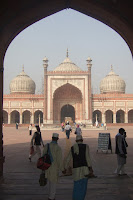 Shoes were less than a quarter of the prices back home, but some of the traders could do with some advice on the way company names translate to foreign eyes.
I eventually spent three nights in Delhi and my entertainment every night was to wander the streets of the Karol Bagh district, looking at the shops and stalls, eating the local foods, chatting to people in tortured English and Hindi and extravagant gestures.


 Shoes were less than a quarter of the prices back home, but some of the traders could do with some advice on the way company names translate to foreign eyes.
I eventually spent three nights in Delhi and my entertainment every night was to wander the streets of the Karol Bagh district, looking at the shops and stalls, eating the local foods, chatting to people in tortured English and Hindi and extravagant gestures.


The next day was my final day with Raj. While I still had the car I took the opportunity to see the Delhi Mosque, which seemed fairly basic after some I had seen, Gandhi’s memorial and the Indian Museum.

I found the Samadhis park, which is a vast park for the memorials to the founders of the modern Indian State, to be sombre, impressive and humbling. Gandhi would probably not have approved at the size of the place, but I found the quiet, simple memorial to be very fitting for that astonishing, fascinating and world-changing man.


The museum was worth the visit, with some very interesting exhibits on Indian history.
21st March 2008 was Good Friday but in Delhi it was more important as the first day of Holi. The big day is apparently Saturday, but in Delhi many of the citizens start early and dye powders and coloured water were being flung around indiscriminately by mid-day Friday. Unfortunately Holi has degenerated in some areas and has become a day when it can be unwise for non-Hindus to be wandering among the revellers. That is particularly true for young women, or for travellers like me trying to circle the world with two pairs of trousers and four shirts that I did not want to become like Joseph’s coat of many colours. This thread on the India Mike forum gives more detail on that problem. I decided discretion was wiser and spent that afternoon in the hotel, catching up on some housekeeping, writing and planning.


Things had settled by the evening so I had dinner at the Sandoz restaurant a few blocks up the road and wandered the markets again, retiring early to get some sleep before my 2am call to get ready to go to the airport. I’ve mentioned that airport departure a few pages ago, so I won’t repeat it all.
Looking back, India was, as advertised, incredible. Some day I may be lucky enough to go again. It is a country of contrasts, rich and abjectly poor, fertile and desert, incredibly modern in some ways, incredibly ancient in others. An enduring memory, un-photographed, is of a camel plodding it’s dusty way along the Delhi road with a wide-screen plasma TV strapped to it’s back.
Next stop, Jordan.
Cheers, Alan


